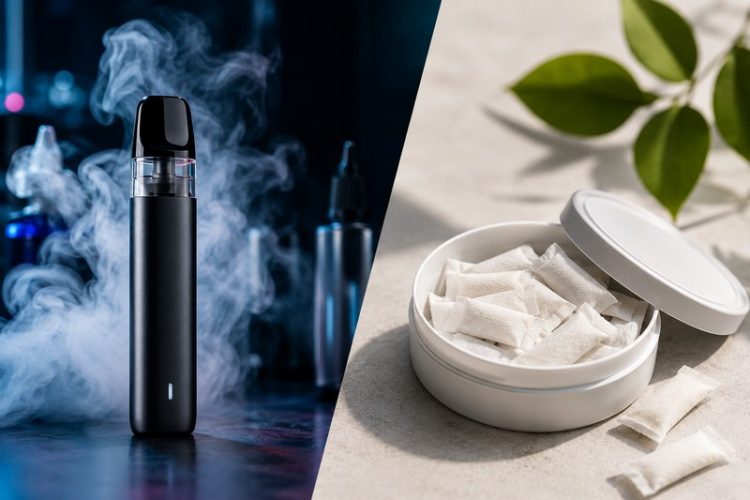
If you vape, you’ve probably noticed pouches creeping into your world. The tins are on the counter at your local vape shop, half the snus-adjacent brands you’ve never heard of are sponsoring podcasts, and at least one mate has stopped asking for charging cables because he’s switched entirely. In the UK, the shift got a hard push in June 2025, when the disposable ban took millions of single-use devices off shelves overnight. Most disposable users moved to pod kits — but a meaningful chunk started looking at nicotine pouches instead, and plenty more now run both.
The nicotine pouches vs vaping question deserves a better answer than the usual listicle, because the two products are not interchangeable. They deliver the same molecule through completely different routes, at different speeds, with different trade-offs. If you understand why a 20mg nic salt in a tight MTL pod feels the way it does, you already have most of the vocabulary you need to understand where pouches will satisfy you — and where they won’t.
One thing up front, because it’s true regardless of which side you land on: nicotine is addictive in every format, neither vaping nor pouches is risk-free, and both are adult products for existing nicotine users aged 18+, not something to pick up from scratch.
Two Routes to the Same Molecule
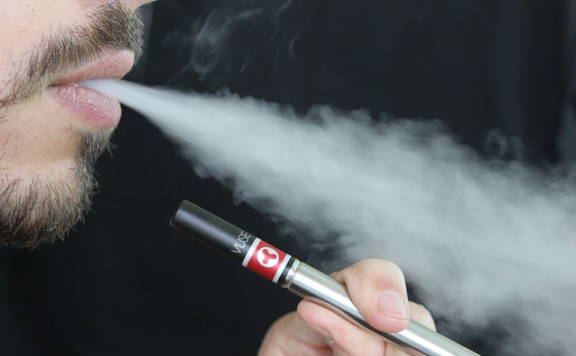
Vaping is pulmonary delivery. Aerosol carries nicotine deep into the lungs, it crosses the alveolar membrane into arterial blood, and it reaches the brain in seconds. That’s why a couple of draws on a 20mg salt device takes the edge off a craving almost instantly — and it’s why nic salts exist at all: benzoic acid lowers the pH so high strengths stay smooth enough to inhale. Fast on, relatively fast off. It’s also why chain vaping is a thing; the hit fades, so you go back.
Pouches are buccal delivery. A pouch sits between your upper lip and gum, releases nicotine into saliva, and the oral mucosa absorbs it into venous blood. Pharmacokinetic studies consistently show pouches reaching peak blood nicotine somewhere in the 20–60 minute range, versus seconds-to-minutes for inhaled nicotine. The first noticeable effect arrives inside five minutes or so — often with a tingle or light burn under the lip that new users mistake for something being wrong (it isn’t; it fades with use) — but the full effect builds gradually and then stays. A typical pouch is worn for 20–45 minutes and delivers a long, flat plateau rather than a spike.
That single difference — spike versus plateau — explains almost everything else in this comparison. Vaping is a series of small, immediate rewards. A pouch is one decision that covers you for half an hour or more.
The Head-to-Head That Actually Matters
Convenience. This is the pouch’s home turf and it isn’t close. No battery, no charging anxiety at 15%, no coil that chose today to die, no e-liquid bottle leaking in your bag, no pod losing flavour after two days. A tin of 20 pouches weighs almost nothing and cannot malfunction. Every vaper knows the specific despair of a dry hit from a spent coil mid-commute; pouches simply have no failure mode.
Discretion. Vapour is visible, scented, and increasingly unwelcome. Even “zero vapour” stealth techniques don’t survive an office, a train carriage or a parents’ evening. A pouch is invisible in use. Nobody knows unless you tell them. For anyone whose nicotine use has to coexist with a professional environment, this is frequently the deciding factor.
Cost over time. Vaping’s headline cost is deceptively low, but the real spend is a drip-feed: coils or pods on a rolling basis, e-liquid, replacement devices when batteries degrade, the occasional impulse tank. Pouches have exactly one recurring cost — tins — which makes budgeting trivially predictable. For moderate users the totals often land in similar territory; heavy chain-vapers who convert usually spend less on pouches, while someone who runs a rebuildable with DIY liquid will spend less vaping. The honest answer is that pouches win on predictability more than on raw price.
Flavour. Vaping wins, decisively. E-liquid flavour is a full sensory experience — retrohale, density, the difference a fresh coil makes. Pouch flavour is closer to strong chewing gum: mint, citrus, berry, coffee, delivered as a taste in your mouth rather than an inhaled cloud. Good pouches are genuinely pleasant, but if flavour chasing is half the reason you vape, pouches will feel muted.
Satisfaction. Depends what you’re satisfying. If it’s the nicotine itself, pouches are extremely effective once you’ve matched strength properly — arguably more so, because the plateau prevents the trough-and-spike cycle that has you reaching for the pod every ten minutes. If it’s the ritual — hand to mouth, the draw, the exhale, the throat hit — pouches replace none of it. This is the single biggest reason switches fail, and it’s worth being honest with yourself about which one you’re actually addicted to.
Hardware faff. Some vapers genuinely enjoy the hobby side: builds, ohms, airflow tuning. If that’s you, “no hardware” is a loss, not a win. If your device is purely a nicotine appliance, pouches remove a chore.
Switching, Dual-Use, and Getting the Strength Right
Most people don’t switch cold; they run both. Pouches for flights, shifts, meetings and nights out; the vape at home. That dual-use pattern is common enough that it’s arguably the mainstream way UK vapers use pouches now, and anywhere sensible to buy nicotine pouches will carry everything from 4mg starter tins to the strong Scandinavian-style brands to cover both ends of it.
Strength mapping is where new pouch users get it wrong, because the numbers don’t mean the same thing. Vape strength is concentration — 20mg per millilitre, drawn on gradually. Pouch strength is the total nicotine in one pouch, of which you typically absorb only a fraction (roughly a third to a half, depending on how long you keep it in). So a 10mg pouch is not “half a ml of 20mg liquid” — it’s its own scale.
As a working guide:
| What you vape now | Sensible starting pouch | Pouch-world label |
| 10mg nic salts, MTL pod | 4–6mg | Regular |
| 20mg nic salts, frequent use | 8–11mg | Strong |
| 3–6mg freebase, sub-ohm/DTL | 4–6mg | Regular |
Two notes on that table. First, sub-ohm vapers at “low” strengths inhale far more liquid per session than the number suggests, so don’t map 3mg liquid to a 3mg pouch and expect nothing — start regular, not mini. Second, the 14–20mg “extreme” pouches that dominate certain Scandinavian-style brands are not a starting point for anyone, including committed 20mg salt users. Buccal delivery keeps climbing for the best part of an hour; a pouch that feels fine at minute five can have you dizzy, nauseous and sweating at minute twenty-five. If that happens, the strength is too high — spit it out, drop down a level, and give a strength a few days before judging it. Under-shooting is the safer error: you can always add, you can’t un-absorb.
Where Pouches Fit the Rules Vaping Doesn’t
This is the practical argument that converts the most UK vapers. Vaping is banned or unwelcome in a growing list of places: flights (absolutely, everywhere, no exceptions), trains and stations, offices, football grounds, hospitals, most pubs’ interiors. A pouch produces nothing — no vapour, no smell, nothing to detect — so smoke-free and vape-free rules generally don’t touch it. You can carry tins through UK airport security without the liquids bag dance, and use one in seat 23F on the way to Alicante while the vapers on board white-knuckle it for three hours. (Check your airline’s policy and, more importantly, your destination’s law — France, notably, banned pouches in 2026, and several other countries restrict them.)
Regulation at home is tightening sensibly rather than punitively. The Tobacco and Vapes Act received Royal Assent in April 2026 and brings pouches into a proper framework — most importantly a legal age of sale of 18, closing a loophole that had genuinely needed closing, with powers over flavours, strengths and marketing to follow. Pouches remain legal to buy and use for adults.
The Honest Limitations
Fairness demands the other side of the ledger. Pouches are newer than vaping, and the long-term evidence base is thinner — UK public health bodies have decades-adjacent data on vaping and comparatively little on pouches. The NHS position is that vaping is far less harmful than smoking and an effective quit tool; the OHID evidence review reached similar conclusions while calling for proportionate pouch regulation. Neither body positions pouches as a health product, and nor should this article: the reasonable claim is that they’re smoke-free and vapour-free, not that they’re harmless. Gum irritation and lip tingle are common early on. The slow onset frustrates spike-chasers. And because the ritual vanishes, some switchers end up using more nicotine, parking pouch after pouch without the natural stopping point a dead battery used to provide.
FAQ
Are nicotine pouches better than vaping?
Neither is “better” — they’re optimised for different things. Pouches win on convenience, discretion, zero hardware and usability where vaping is banned. Vaping wins on speed of delivery, flavour intensity, throat hit and ritual. Most satisfied users pick based on context rather than picking a side, and both are far preferable to smoking for existing nicotine users.
What pouch strength equals 20mg nic salts?
There’s no exact equivalence because the units measure different things, but in practice most frequent 20mg salt vapers land happily on 8–11mg pouches. Start there rather than at the 14mg+ extreme tiers — buccal absorption builds slowly and overshooting is genuinely unpleasant.
Can I use nicotine pouches on a plane?
You can carry them through UK security with no liquid restrictions, and because they produce no vapour they aren’t caught by the smoking ban on board — though a few airlines restrict oral nicotine products, so check your carrier. Verify your destination country’s rules too, as pouch legality varies internationally.