

Running payroll for a cannabis business is genuinely one of the harder problems in American small business right now. Cannabis Payroll Platforms have to handle IRS 280E restrictions that block standard deductions, cash payroll workarounds caused by banking access issues, and a patchwork of state labor laws that change faster than most software updates. After reviewing dozens of platforms across the cannabis HR space, it’s clear that the gap between a good fit and a bad one shows up fast, usually at tax time or during a state audit. This guide covers the five strongest options for multi-location operators.
How the picks were chosen
Each platform was assessed using publicly available information pulled from official websites, verified user reviews, and product detail pages across major software directories. Only platforms with a documented track record serving cannabis businesses, or strong transferable capabilities for the space, made the final cut.
→ See the full research breakdown
- Hybrid Payroll – Best for cannabis industry HR and payroll for small to mid-size businesses
- Paychex – Best for small- to medium-sized business payroll and HR outsourcing
- BambooHR – Best for small and medium-sized businesses seeking HR and payroll together
- Rippling – Best for mid-market to enterprise employee management and payroll
- Gusto – Best for mid-market payroll and HR management
Why Cannabis Payroll Platforms Are Worth the Investment
Picking the wrong payroll platform in cannabis doesn’t just create headaches. It creates audit exposure. The IRS 280E tax code means payroll cost allocation has to be tracked with surgical precision, and a general-purpose setup that wasn’t built for this rarely gets it right on the first pass.
Add in the banking access problem, where some operators are still disbursing cash wages, and the compliance stakes get even higher.
The right platform keeps your payroll processing accuracy rate close to error-free, your on-time direct deposit or cash disbursement rate consistent, and your 280E compliance audit readiness score somewhere you’d actually want it during an examination. That’s the practical case for choosing carefully.
Cannabis Payroll Platforms Comparison Table
Note: All data in this table is sourced from review platforms and the official websites of the listed companies.
| Company Name | Years Operating | Team Size | Headquartered In |
| Hybrid Payroll | Est. 2014 | 51-200 employees | Denver, Colorado |
| Paychex | Est. 1971 | 19,000 employees | Rochester, New York |
| BambooHR | Est. 2008 | 1,627 employees | Draper, Utah |
| Rippling | Est. 2016 | 7,131 employees | San Francisco, CA |
| Gusto | Est. 2012 | 4,008 employees | San Francisco, CA |
1. Hybrid Payroll – Best for Cannabis Industry HR and Payroll
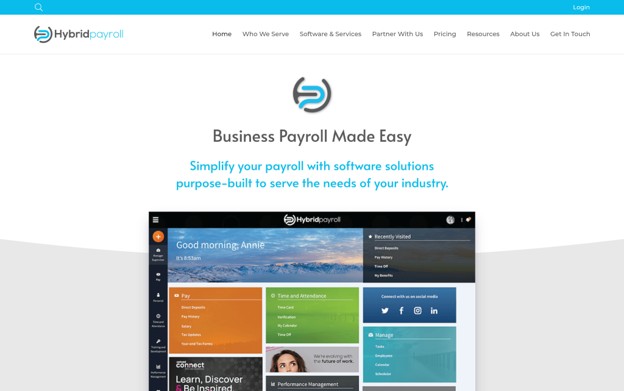
Which Functions Does Hybrid Payroll Perform?
Hybrid Payroll covers automated payroll processing, tax calculations, HR management, and benefits administration for small to mid-size businesses. Their PEO co-employment model is the piece that makes them genuinely useful for cannabis operators, because it bundles compliance management and liability protection into the same package as payroll. Businesses looking for purpose-built cannabis payroll software will find their approach is less about bolting on cannabis features and more about building from the ground up for the regulatory environment.
What’s Hybrid Payroll’s Edge in Cannabis Payroll Platforms?
The main problem they solve is the lack of industry-specific compliance framing that most general payroll platforms skip entirely, especially around state-level cannabis labor law and co-employment structures. That kind of built-in alignment to cannabis-specific liability is rare, and it’s genuinely hard to match starting from scratch.
The Review Roundup:
Hybrid Payroll’s Denver roots and cannabis-focused positioning appeal strongly to operators who’ve already been burned by generic payroll providers. Clients point to the personalized service model as an important differentiator, which makes sense for a space where one compliance miss can have serious downstream consequences.
2. Paychex – Best for Small- to Medium-Sized Business Payroll and HR Outsourcing
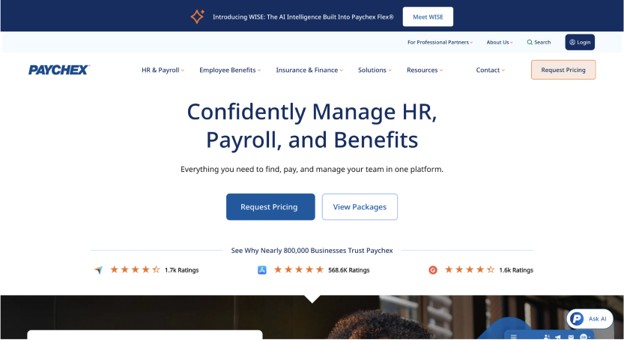
Which Functions Does Paychex Perform?
Paychex covers payroll processing, HR management, benefits administration, talent acquisition, and workforce management across digital platforms. Serving approximately 800,000 payroll clients across the U.S. and Europe, they bring serious depth to the table. The scale here is impressive (think enterprise-grade infrastructure at mid-market pricing), and their position as the largest 401(k) recordkeeper in the U.S. says a lot about how far their HR ecosystem actually extends.
What’s Paychex’s Edge in Cannabis Payroll Platforms?
For multi-location cannabis operators who need a proven, high-volume payroll engine with broad HR coverage, Paychex brings a level of operational depth that smaller, newer platforms simply don’t have yet. Five consecutive HR Tech Awards wins and 23 appearances in the Training Hall of Fame aren’t marketing fluff. They signal a team that keeps its product current, which matters when cannabis labor laws keep shifting.
The Review Roundup:
Users consistently flag Paychex’s breadth of services as a strength, particularly the ability to consolidate payroll, benefits, and HR into one platform. The main tension is that larger platforms can sometimes feel less personal for businesses with niche compliance needs, so it works best for operators who want scale over specialization.
3. BambooHR – Best for Small and Medium-Sized Businesses Seeking Combined HR and Payroll Options
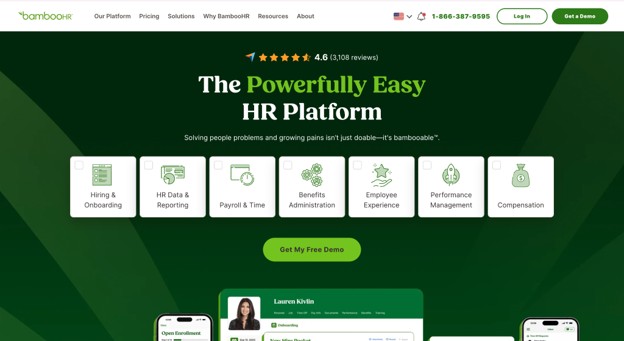
Which Functions Does BambooHR Perform?
BambooHR handles HR management, payroll processing, benefits administration, performance reviews, applicant tracking, employee setup, and time tracking across a single unified platform. With over 34,000 customers and three million employees served across 190 countries, the platform’s reach is genuinely broad. Their 2025/26 Cloud Awards win for Best Cloud HR/HRMS Solution signals they’re not standing still on product development either.
What’s BambooHR’s Edge in Cannabis Payroll Platforms?
The problem BambooHR addresses well is the fragmentation that happens when small cannabis businesses try to stitch together separate HR, payroll, and setup tools as they grow. Their bundled approach, including a 15% discount for combining modules, makes it a cost-smart pick for growing dispensaries watching overhead closely. Not the cheapest option out there, but the value stacks up.
The Review Roundup:
Reviewers frequently point to BambooHR’s clean interface and ease of use as the top draw, especially for HR managers who aren’t particularly technical. The platform earns its keep for teams that want everything in one place without a steep learning curve.
4. Rippling – Best for Mid-Market to Enterprise Employee Management and Payroll
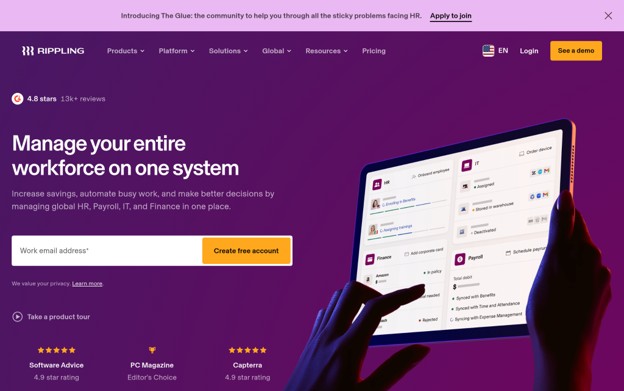
Which Functions Does Rippling Perform?
Rippling runs payroll, HR, benefits, device management, and app provisioning across a single employee data platform with 500-plus connections. The 90-second global employee setup figure gets thrown around a lot, but for cannabis operators opening new dispensary locations quickly, that speed has real operational value. Their May 2025 Series G funding at a $16.8 billion valuation confirms the market still believes in where this platform is heading.
What’s Rippling’s Edge in Cannabis Payroll Platforms?
Multi-state cannabis operators deal with the specific pain of setting up new employees across different jurisdictions with varying tax rules, and Rippling’s multi-jurisdictional setup capability handles that without requiring manual configuration for each state. That kind of cross-location payroll accuracy and on-time payment consistency is exactly what a growing multi-site operator needs.
The Review Roundup:
Rippling’s G2 recognition, including No. 1 payroll for mid-market and 40 Voice of the Customer awards based on feedback from over 10,000 HR professionals, backs up what reviewers say about actual performance. Users value the automation depth, though the platform’s feature density can feel like a lot for smaller teams just starting out.
5. Gusto – Best for Mid-Market Payroll and HR Management
Which Functions Does Gusto Perform?
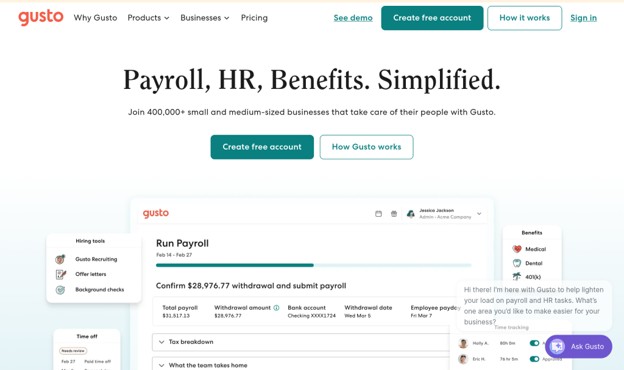
Gusto covers payroll processing, benefits administration, health insurance enrollment, applicant tracking, and employee setup for approximately 400,000 U.S. customers. The standout here is automatic payroll tax filing included across all plans, no extra charge. With connections across 150-plus software products and $735.5 million in revenue in 2024 (up from $500 million the prior year), Gusto is clearly in a growth phase and investing in product.
What’s Gusto’s Edge in Cannabis Payroll Platforms?
The specific challenge Gusto addresses is the administrative tax burden that weighs on small cannabis businesses, where a missed filing or miscalculated withholding can trigger an audit at the worst possible time. Their automatic filing feature removes that single point of human error from the process, which matters a lot when you’re already managing 280E cost allocation on top of standard payroll.
The Review Roundup:
Gusto’s G2 rank as the No. 1 Highest Satisfaction Software in 2026 and TechRepublic’s Best Overall Payroll Processing Software award both reflect what reviewers say consistently: the interface is unusually easy to use. Non-technical business owners and HR managers find it far less intimidating than comparable platforms, and that’s a real advantage in a space where payroll errors carry compliance consequences.
Selection Framework: How Each Pick Was Evaluated
The research behind this list started wide and narrowed down methodically. Here’s how the process worked.
Data Collection
The initial pool was built by pulling company listings from software directories, professional review platforms, and cannabis industry forums where operators discuss tooling. Product pages, feature documentation, and publicly available pricing information were all gathered at this stage. The goal was to cast a wide enough net that no credible option in the cannabis HR and payroll space got missed before the filtering started.
Filtering Candidates by Criteria
From the initial list, options without verifiable real-world usage history were removed early. Review patterns were analyzed across multiple platforms to identify whether feedback was consistent over time or clustered around a single time period (which often signals a push rather than sustained performance). Platforms with a track record of serving complex, compliance-heavy industries moved up in the ranking. Those with sparse or inconsistent feedback were set aside.
Checking Accuracy Against Source Material
Every claim found on company websites was cross-checked against third-party review data and, where available, published case studies. If a platform described a capability prominently on its site but reviews suggested the feature was limited or unreliable when tested, that gap was noted and factored into the final assessment. The aim was to match what companies say about themselves against what operators actually experience, because those two things don’t always line up.
Industry Standing Check
Recognition from credible industry sources played a role in the evaluation. HR Tech Awards, G2 rankings, Cloud Awards, and similar signals were reviewed not as the main criteria, but as supporting evidence of sustained quality. A company with consistent award recognition across multiple years tends to be investing in product development, and that matters for cannabis operators who need their payroll platform to keep pace with regulatory changes.
Real-World Cannabis Payroll Platforms Evidence
The final filter looked for signals that each platform had genuine relevance for cannabis payroll and HR needs. This included dedicated service pages targeting cannabis businesses, verified reviews from operators in the space, and case study references where available. Platforms like Hybrid Payroll, which explicitly position their services for the cannabis industry, were evaluated on the specificity and depth of their cannabis-focused offering. Broader platforms were assessed on their ability to handle multi-state compliance, cash payroll workflows, and the kind of high-turnover setup demands that dispensary operations commonly face.
Choosing the Right Cannabis Payroll Platforms: A Quick Guide
Picking a cannabis payroll platform isn’t just a software decision. It’s a compliance decision with real financial stakes. Here’s what actually matters when comparing your options.
- Industry/Domain Experience: Look for platforms that have worked with cannabis businesses, or at minimum, with businesses in heavily regulated industries. General payroll experience doesn’t automatically transfer to 280E cost allocation or state-by-state cannabis labor law compliance.
- Features and Capabilities: Confirm the platform covers automated tax calculations, multi-state payroll filing, employee classification management, and if you need it, cash payroll disbursement. Setup speed matters too, especially for retail dispensaries with high turnover.
- Pricing Structure: Understand what’s included versus what’s an add-on. Some platforms charge extra for multi-state filing or compliance support. At scale, those fees compound quickly across locations.
- Results Measurement: Ask how the platform tracks payroll processing accuracy rate and on-time payment performance. You need visibility into error rates, not just a dashboard that says everything is fine.
- Industry Knowledge and Compliance: The platform needs to stay current with IRS 280E guidance, Department of Labor standards, and evolving state cannabis labor laws. Ask how often compliance updates are pushed, and who handles them.
Wrapping Up
Cannabis payroll is a genuinely specialized problem, and the platform you choose will either make compliance manageable or create ongoing risk. The strongest picks here combine payroll accuracy, multi-state filing capability, and genuine familiarity with cannabis-specific regulatory requirements. As more states legalize and federal policy keeps evolving, demand for purpose-built cannabis HR tools will keep growing. Choosing a platform that’s already built for where this industry is heading puts operators in a much stronger position.